
Mounting
Here you can find the assembly material for the mounting of the solar panels. We offer complete systems and individual parts from various manufacturers. This means that the right material can be provided for every type of installation.
Because wind and snow loads can vary significantly depending on the building’s location—and every roof construction is different—the mounting structure for a PV system must be designed individually. There is no one-size-fits-all mounting frame. Specific features of the substructure and the roof covering may require special solutions in certain cases. By having the mounting system designed by the mounting system manufacturer, you receive a statically verified proof that the mounting structure can withstand the expected loads without doubt.
Please note that a design provided by the mounting system manufacturer applies only to their own product. This means you cannot simply use one manufacturer’s bill of materials for a different manufacturer. Important: the mounting system manufacturer does not provide a structural assessment of the roof itself. Strictly speaking, the party installing the PV system must verify whether the roof structure can carry the additional load of the PV system.
Pitched roof
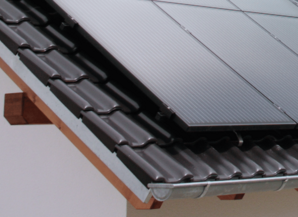
For roofs covered with clay tiles or concrete roof tiles, a system with roof hooks and mounting rails is typically used as standard. Installation is especially cost-effective on trapezoidal sheet metal roofs. In most cases, short rails can be used here, which are screwed directly into the roof skin. For bitumen and corrugated roofs, hanger bolts are often used. These are screwed into the underlying wooden rafters, and EPDM rubber seals are used for waterproofing. For roofs with standing seam metal, a suitable seam clamp is used. Since the seam clamp is in direct contact with the standing seam, it’s important to check which material the seam is made of in order to avoid chemical reactions between different metals.
Flat roof
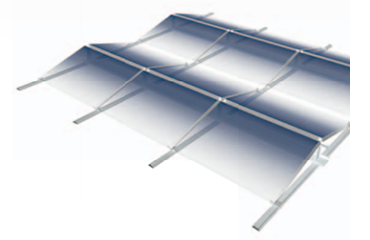
On flat roofs, modules are typically mounted on frames with a tilt of around 10° to 15°. A relatively simple solution is provided by plastic mounting trays such as the Console+ from Renusol. It is also possible to mount solar modules parallel to the roof on a flat roof. In most cases, ballasting the mounting structure is sufficient to secure it. In rare cases, it must be screwed down—for example, if the roof cannot carry the ballast or if wind loads are too high. The ballast elements are usually provided on-site by the customer/installer.
On a flat roof, it is also possible to mount systems at tilt angles of over 50°. This is very cost-intensive and requires a huge amount of ballast, or the system must be mechanically fixed (screwed down).
Important: In any case, you should calculate the required ballast for your location.
Façade mounting
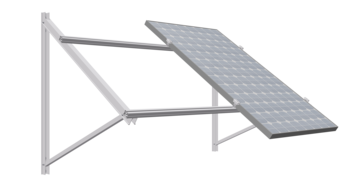
If there is no more space available on the roof surfaces, PV modules can also be installed on the building façade. This can be done either flush-mounted parallel to the wall or on a tilted mounting structure.
In-roof solutions
Some module manufacturers also offer in-roof solutions where the modules replace the roof covering. In other words, the modules take the place of roof tiles. This solution is relatively expensive and is usually only worth considering when a roof is being newly built or renovated.
If you have any further questions about the mounting structure, system design, or ballasting, we’ll be happy to help. Simply contact us and give us a call.
Image source: Schletter