We have a new online shop!
If something in our new shop does not work or is missing, we would greatly appreciate your feedback. Please contact us via our contact form or give us a call:
+49 8726 910037
×
+49 8726910037
  • Service

Solar Panels

Solar Panels 

Here you can find a large selection of solar modules from tested and reliable manufacturers. Different module types offer advantages for different purposes. 
 
Would you like to know more about solar panels? Then please read our article on solar modules.

Generate your own electricity with solar modules and save money! – What should you consider when choosing? Here’s our buying guide!

Photovoltaic Module Buying Guide & Comparison

Heckert Solar photovoltaic modules “Made in Germany” combine high quality with a fair price, creating strong demand and highly satisfied customers. Many Asian manufacturers have also established themselves in the market thanks to reliable quality and excellent value for money, offering strong alternatives at a lower price point. Here you will find modules from brands such as Trina, LONGi, Jinko, JA Solar, or Aiko Solar.

The following key criteria will help you compare solar modules:

Efficiency

Efficiency indicates what share of the sunlight hitting the PV module is converted into electricity. The higher the efficiency, the more electricity is generated per m² of module area. If you have enough space available to achieve the desired PV capacity, more affordable solar modules with a lower efficiency can still be a sensible alternative. In general, efficiency—like price—is closely linked to the cell technology used in today’s half-cell modules and typically ranges from 20% to 24%.

Certification and Testing

Modules tested and certified in accordance with the IEC EN 61215 standard have proven to be stable and reliable during the test procedure. The certification is listed in the module’s datasheet. In addition, all modules are tested for mechanical load capacity under snow loads and for hail resistance. The datasheet usually provides this information as well.

Product Warranty

Most manufacturers offer a product warranty of at least 15 years. Check whether the warranty is backed by an insurance provider, and look into the manufacturer’s registered office to get a sense of whether warranty claims can realistically be enforced. If in doubt, choose manufacturers you can reasonably expect to still be in business many years from now.

Performance Warranty

The performance warranty states the maximum power loss the solar module is allowed to have over its lifetime. In most cases, manufacturers guarantee at least 90% of the rated output after 10 years and 80% after 25 years. Since the customer must prove that the module is underperforming, it also makes sense here to take a closer look at the warranty terms and conditions.

Which cell types are available for PV modules?

Modules with monocrystalline cells

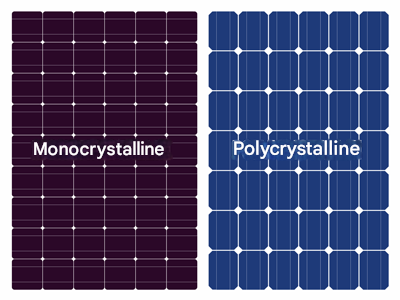
Monocrystalline solar cells are made from a single, highly pure silicon crystal. In a complex process, a cylindrical single crystal—known as an “ingot”—is formed and then sliced into thin wafers (approx. 0.2 mm). The wafers are then cleaned, doped, coated with an anti-reflective (AR) layer, and assembled into a solar module. Despite the elaborate manufacturing process, monocrystalline PV modules have become the affordable market standard. They perform very well in low-light conditions and currently offer the highest efficiency, which means you need less roof area to generate a high amount of electrical energy. Today, almost every solar cell used on the market is monocrystalline.

N-type vs. P-type: What’s the difference?

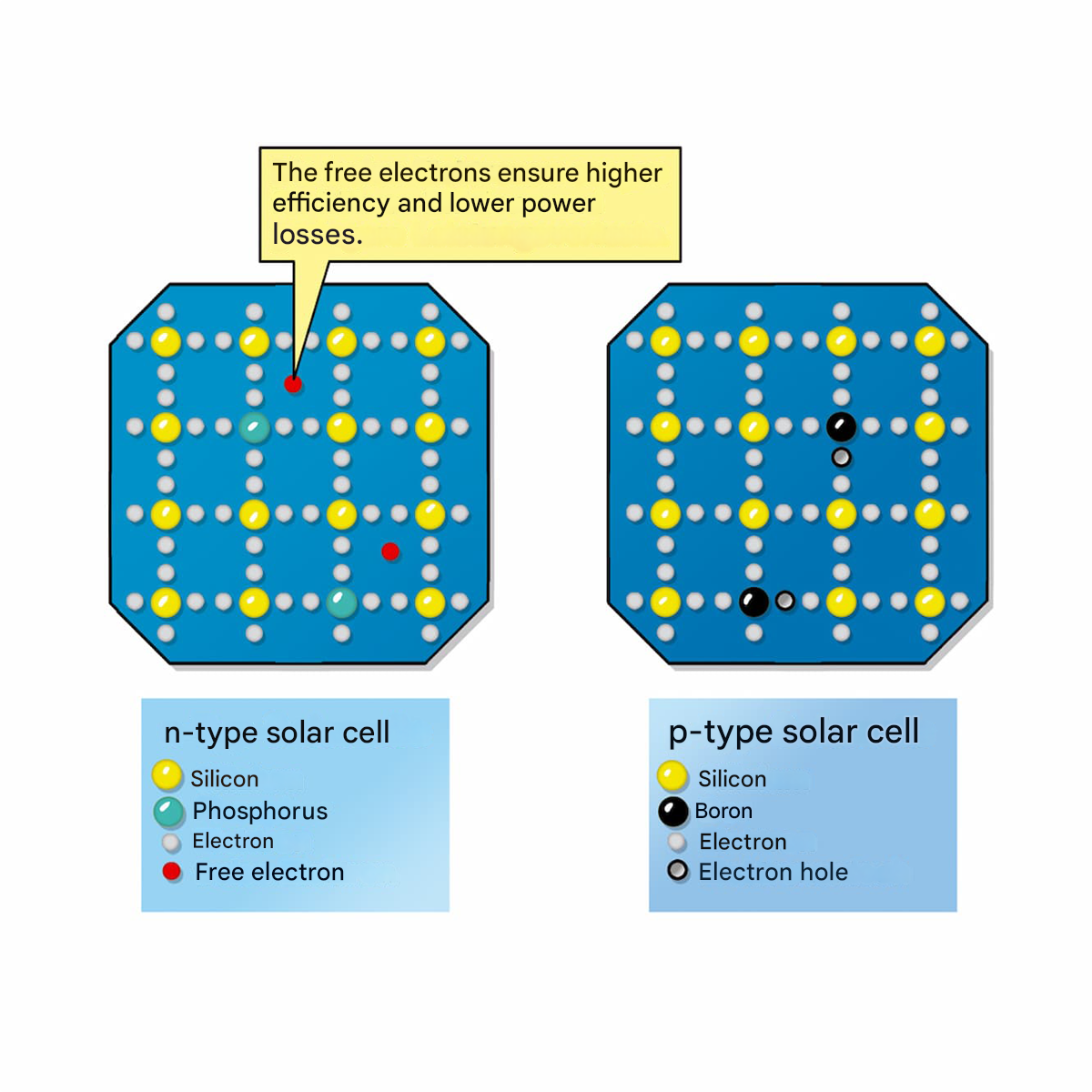
“N-type” stands for negative-type (negatively doped) solar cells. These are solar cells in which the semiconductor is doped with negatively charged electrons. Compared with P-type (positively doped) cells, N-type cells offer several advantages—this is why they have increasingly become the market standard:

  • Lower recombination losses: N-type solar cells often have lower losses from electron–hole recombination, which can result in higher efficiency.
  • Better performance at higher temperatures: N-type solar cells tend to perform better at elevated temperatures than P-type cells.
  • Less susceptible to impurities: N-type solar cells are less sensitive to contamination by foreign atoms, which can improve their long-term stability.
  • Lower light-induced degradation (LID): Doping with phosphorus instead of boron helps prevent the formation of boron–oxygen defects under sunlight.

PV modules with PERC solar cells

PERC (Passivated Emitter and Rear Cell) solar cells increase efficiency by adding a passivation layer on the rear side that reflects more light back into the cell for a second pass. This boosts light yield and reduces energy losses caused by recombination. While PERC-based solar modules are very cost-effective, they are increasingly being replaced on the market by newer technologies.

Solar modules with heterojunction cell technology (HJT)

Heterojunction technology combines two semiconductor materials (e.g., crystalline and amorphous silicon) with different properties. This structure improves efficiency by reducing recombination losses and enabling more effective energy conversion.

  • High efficiency: Combining the materials improves the separation of charge carriers (electrons and holes), reducing recombination and increasing electrical efficiency.
  • Low temperature sensitivity: Heterojunction solar cells have a lower temperature coefficient, meaning they remain more efficient at higher operating temperatures than conventional solar cells.
  • Long service life: Using amorphous silicon for surface passivation can extend the cell’s lifetime.

TOPCon modules – today’s market standard

TOPCon stands for “Tunnel Oxide Passivated Contact”. It is a solar cell technology used to passivate contacts (typically on the front side), with the core goal of minimizing charge-carrier recombination at the contacts. Advantages of TOPCon solar cells include:

  • Higher efficiency: TOPCon technology enables very low charge-carrier recombination at the contacts, increasing cell efficiency.
  • Excellent contact passivation: Contact passivation is achieved via a tunnel oxide layer, which effectively reduces surface recombination.
  • Flexibility: TOPCon can be combined with different cell architectures, providing flexibility in solar cell manufacturing.
  • N-type TOPCon solar modules are currently the best-selling module type on the market.

PV modules with back-contact solar cells – the latest technology

Back-contact cells have no silver busbars on the front side. You’ll find them under abbreviations such as IBC technology (“Interdigitated Back Contact”), LONGi’s HPBC technology (“Hybrid Passivated Back Contact”), or AIKO’s ABC technology (“All Back Contact”). The conductive contact fingers that carry the current away from the cell are installed exclusively on the rear side. This offers several advantages:

  • Very high efficiency, because the full cell surface can be exposed to sunlight and the rear-side contacts can be wider and therefore more conductive.
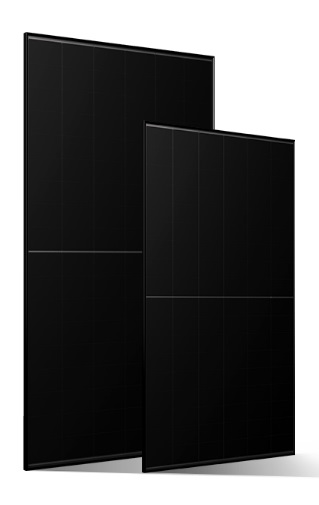
  • Uniform, all-black appearance, since no contact strips are visible on the front.
  • Long service life: early tests indicate low degradation and very strong durability.

Glass-glass modules

Glass-glass modules are a special type of solar module in which both the front and the rear side are made of glass. Compared to conventional solar modules with a polymer backsheet, these dual-glass modules offer a range of advantages and are increasingly becoming the standard:

  • Longer service life: Glass-glass modules are generally more durable than conventional modules with a polymer backsheet. They are less susceptible to weathering, temperature fluctuations, and UV radiation, because glass is more resistant to environmental stress than plastic.
  • Improved stability: The dual-glass structure—similar to laminated safety glass—makes these modules more robust and more resistant to mechanical loads. They are less prone to warping or cracking, which is especially beneficial in regions with extreme weather conditions.
  • Better moisture resistance: Glass-glass modules provide higher moisture resistance compared to modules with a polymer backsheet. This reduces the risk of moisture ingress and corrosion, which in turn improves performance and service life.
  • Enhanced fire safety: Glass is non-combustible, so glass-glass modules typically offer higher fire safety than modules with a polymer backsheet.
  • Improved aesthetics: Glass-glass modules often have a premium look and can integrate better into different architectural environments. The dual-glass design can also contribute to a modern appearance.
  • Better heat dissipation: Glass has higher thermal conductivity than plastic. This means glass-glass modules tend to dissipate heat more efficiently, which can improve module performance in hot conditions.

Tip for choosing dual-glass modules
Dual-glass modules are currently available with different glass thicknesses. You can find modules with 2× 1.6 mm glass and with 2× 2.0 mm glass. If you want even more stability and durability, look for the 2× 2.0 mm option.

Bifacial modules

Glass-glass modules can be bifacial. This means the cells are also exposed on the rear side and can generate electricity when light hits the back of the module.

Some glass-glass modules only have white or black foil in the gaps between the individual cells. These are also bifacial. Some glass-glass modules, however, have a full-area backsheet/foil behind the cells (between the glass layers) and are therefore not bifacial—those modules have a white or black rear side.

Design

PV modules with back-contact solar cells – the latest technology

Back-contact cells have no silver busbars on the front side. You’ll find them under abbreviations such as IBC technology (“Interdigitated Back Contact”), LONGi’s HPBC technology (“Hybrid Passivated Back Contact”), or AIKO’s ABC technology (“All Back Contact”). The conductive contact fingers that carry the current away from the cell are installed exclusively on the rear side. This offers several advantages:

  • Very high efficiency, because the full cell surface can be exposed to sunlight and the rear-side contacts can be wider and therefore more conductive.
  • Uniform, all-black appearance, since no contact strips are visible on the front.
  • Long service life: early tests indicate low degradation and very strong durability.

Yield losses caused by shading and unfavorable orientations

Modules are installed in series-connected “strings”. The module with the lowest output in a string—like the weakest link in a chain—sets the maximum performance for all other modules in that string. If long shadows stretch across the roof or unfavorable orientations threaten to reduce yield, power optimizers can offer a solution. They lower the voltage of the weaker modules in a string while increasing their current to match the level of the better-performing modules. Additional benefits include monitoring individual modules and enabling complex layouts and different orientations. Read more here

Complete Solar Kits

Don’t want to go through the effort of choosing solar modules and a matching inverter yourself? Then take a look at our complete systems! We’ve already put together a selection of PV systems where the solar modules and the inverter are perfectly matched.

Personal consultation

Still not sure which PV module to choose? Then get in touch with us! With hands-on experience and in-depth market knowledge, we can help you even with individual requirements and special cases. Or fill out our request form and we’ll create a quote tailored to your needs. We offer solar modules that match your expectations.