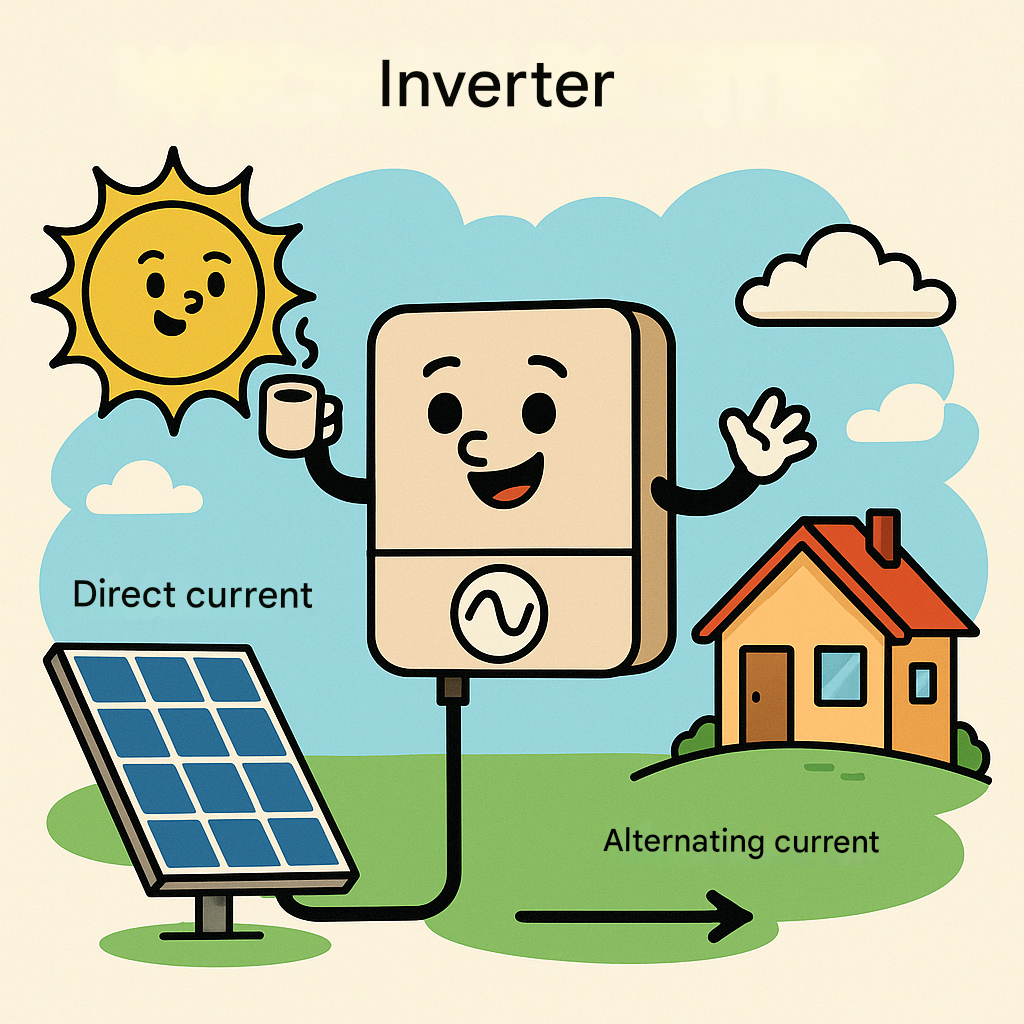
An inverter is a central component of every PV system. Its main task is to convert the direct current (DC) generated by the solar modules into alternating current (AC) that can be used in the public grid or consumed directly in your home. Photovoltaic modules produce electricity only as DC—this cannot be used directly in a standard power grid or fed into a wall socket. Only after conversion into grid-compatible AC with a frequency of 50 Hz and a voltage of 230 V (or 400 V for three-phase systems) does solar power become usable.
In addition to the core DC-to-AC conversion, a modern inverter performs many other tasks as well.
MPP tracking (Maximum Power Point Tracking)
The inverter ensures that the solar modules always operate at the point of maximum power output. This point varies depending on irradiance, temperature, and module orientation. MPP tracking maximizes energy harvest and therefore the efficiency of the entire system.
Grid monitoring and feed-in
The inverter continuously checks whether the power grid is stable (voltage, frequency, phase angle). It only feeds electricity into the grid under safe grid conditions. If deviations occur (e.g., voltage spikes or a grid outage), it automatically disconnects the system from the grid—a safety mechanism known as automatic grid disconnection.
Monitoring and communication
Most inverters record data such as energy production, operating hours, faults, and voltage levels. This information is displayed via an app, a web portal, or an onboard display. This allows system owners to monitor their system’s performance in real time.
Battery and hybrid functions (optional)
Hybrid inverters also include an integrated battery charge controller. They enable solar energy to be stored in a battery storage system and used later—ideal for maximizing self-consumption.
Safety functions
Inverters detect faults or insulation errors (e.g., due to damaged cables) and shut down in critical situations. Integrated arc-fault protection is now also a standard feature to help prevent fires caused by electrical faults.
Shade management (depending on the manufacturer)
Shade management is a feature of modern inverters that reduces power losses caused by partial shading of PV modules. It is an intelligent control function that becomes especially important when individual modules in a PV system are temporarily shaded—for example by trees, chimneys, dormers, antennas, or neighboring buildings. A distinction is made between the global MPP and local MPPs. When all modules are in full sun, there is only the global MPP. If some modules are shaded, one or more local MPPs appear in addition to the global MPP. An inverter without shade management can get “stuck” at a weaker local MPP under shading conditions and waste energy. An inverter with shade management periodically searches for the global MPP and adjusts its operating point accordingly.
Single-phase inverters
These feed solar power into the home’s electrical system on just one phase. They are commonly used for smaller systems (up to around 4–5 kWp), for example on single-family homes, carports, or garden buildings. Advantages:
Three-phase inverters
These feed electricity evenly across all three phases. They are used for larger PV systems—and in Germany, they are even legally required from an inverter rating of around 4.6 kVA. Advantages:
At first glance, it may seem inefficient: a single-phase inverter feeds into only one phase, while loads on other phases might need electricity. You might assume that the self-generated power cannot be used optimally.
This is exactly where a netting (summation) electricity meter comes into play:
A netting meter offsets imported and exported electricity across phases. In other words: if power is fed into phase L1 while electricity is being consumed on L2 and L3 at the same time, the meter first subtracts the self-consumption on all three phases from the power fed into L1. In effect, it is netted as if the solar power were distributed throughout the house—even if, technically, it is injected on just one phase.
Example for illustration:
A PV system with a single-phase inverter feeds 2,000 W into phase L1. At the same time, a dishwasher on L2 consumes 1,000 W and a refrigerator on L3 consumes 500 W.
Without netting: You would export 2,000 W and additionally import 1,500 W from the grid—inefficient.
With netting: The electricity meter offsets everything against each other → only 500 W surplus is exported, and no grid import is required.
A module’s power rating in Wp reflects a laboratory value measured under defined test conditions. This standard was introduced to make module power ratings comparable. In real-world operation, these conditions are rarely met—actual output is usually lower. The table below shows the percentage of the maximum possible yield. The values are based on roof pitch and orientation—i.e., the deviation in degrees from the optimal south-facing direction (0°).
| Pitch | 0° (S) | 30° | 60° | 90° (E/W) | 120° | 150° | 180° (N) |
|---|---|---|---|---|---|---|---|
| 0° | 87 % | 87 % | 87 % | 87 % | 87 % | 87 % | 87 % |
| 10° | 93 % | 92 % | 90 % | 86 % | 83 % | 80 % | 79 % |
| 20° | 97 % | 96 % | 91 % | 85 % | 77 % | 71 % | 70 % |
| 30° | 100 % | 97 % | 91 % | 82 % | 72 % | 64 % | 61 % |
| 40° | 100 % | 97 % | 90 % | 79 % | 67 % | 56 % | 52 % |
| 50° | 98 % | 95 % | 87 % | 75 % | 61 % | 48 % | 43 % |
| 60° | 94 % | 91 % | 82 % | 70 % | 55 % | 41 % | 35 % |
| 70° | 88 % | 85 % | 76 % | 70 % | 49 % | 35 % | 28 % |
| 80° | 80 % | 77 % | 68 % | 56 % | 42 % | 29 % | 23 % |
| 90° | 69 % | 67 % | 60 % | 48 % | 35 % | 24 % | 18 % |
Again: these values represent the maximum possible yield, which is rarely achieved in real life—or only for short moments. You can safely subtract 10–20% from these values to determine a suitable inverter rating. However, since price jumps between the relevant power classes are usually not significant, choosing the next higher rating is often a perfectly good option.
Examples:
A 10 kWp system with a 30° roof pitch and a south-facing orientation has a maximum possible output of 100%. Since this is rarely reached, you can undersize the inverter by 10–20%, which would point to a unit with around 8–9 kW nominal power. An 8 kW inverter would be sufficient for most of the summer, but tends to be too small during the shoulder seasons. Since 9 kW models are uncommon, a 10 kW inverter is usually the best choice.
With an east–west orientation, a 10 kWp system at a 30° roof pitch achieves 82% maximum possible output. Again, since this is rarely reached, you can subtract around 10–20% and end up with an inverter nominal rating of about 6–7 kW. A 6 kW inverter would be sufficient for most of the summer, but tends to be too small in spring and autumn. Since 7 kW models are uncommon, an 8 kW inverter is recommended.
You’re welcome to contact us and we’ll take care of the system design for you.

Different orientations and roof pitches can definitely be connected to a single inverter. With two different orientations, you can choose a unit with 2 MPPTs. If you want to connect east/west and south to an inverter with 2 MPPTs, you can assign east/west to one MPPT—provided the east and west string lengths are identical (parallel)—and connect the south-facing strings to the other MPPT.
Since this topic can be more complex, we’ll be happy to advise you. Just contact us.
Hybrid inverters combine two functions in one device: generating electricity from solar modules and storing it in a battery storage system. Some hybrid inverters also offer a dedicated backup connection to keep a building supplied with solar power from the modules or the battery during a power outage. With some manufacturers, a separate backup box must be installed for this.
Structure of a PV system with a hybrid inverter and battery storage
| A = Solar modules | generates DC power from sunlight |
| B = Hybrid inverter | converts DC from the modules and the battery into AC—and, if required, back again |
| C = Energy Meter / Smart Meter | measures power flow to and from the grid (required in addition to the utility’s household meter) |
| D = public power grid | the utility’s public power grid |
| E = Battery storage | operates on DC power |
| F = Backup connection | supplies the selected backup loads during normal operation and during a power outage |
| G = Home electrical system | has no power during a grid outage |
Why buy a hybrid inverter?
Questions and answers about hybrid inverters
Which battery systems are compatible with a hybrid inverter?
Most modern hybrid inverters are compatible with lithium-ion battery storage systems. Almost every manufacturer provides a compatibility list of supported batteries. Many inverter brands now also offer their own battery storage solutions.
Can a hybrid inverter be operated without a battery?
Yes, a hybrid inverter can also be used without a battery. In most cases, a battery can be added later—provided a compatible battery system is still available.
Converting an older post-EEG (20+ years) PV system to self-consumption with a hybrid inverter
An older PV system that has fallen out of subsidy support after 20+ years often still works perfectly well. However, since the remuneration based on the annual market value for solar is typically quite low, switching to self-consumption can be a good option—provided the building uses enough electricity.
The following can make economic sense:
A battery inverter is a device that is connected on the AC side of the home and operates a battery storage system. Its main function is to convert the home’s AC power into DC in order to charge a battery. Conversely, the battery’s DC power is converted back into AC by the battery inverter so it can be used in the home. Battery inverters can also provide a backup power function, but once the battery is empty, no further backup power can be supplied.
Advantages compared to a hybrid inverter
A hybrid inverter combines the PV inverter and the battery inverter in a single device. However, a separate battery inverter can offer clear advantages in certain scenarios.
Modularity and flexibility
With existing PV systems, a battery storage system can be added later without replacing the original PV inverter.
Batteries and inverters can be sized or replaced independently of each other.
Manufacturer independence
You are not tied to a single system vendor and can combine storage solutions from different manufacturers.
Retrofit-friendly
Ideal for existing systems, as no complete system rebuild is required.
Lower risk in case of failure
If a fault occurs, only one device is affected (PV inverter or battery inverter)—not the entire system as with a hybrid unit.
Disadvantages compared to a hybrid inverter
Despite these advantages, there are also some significant drawbacks.
Lower efficiency
In an AC-coupled system (battery inverter), the energy has to be converted two to three times (PV → AC → battery → AC).
This leads to higher conversion losses (overall system efficiency of 85–92%).
A hybrid inverter typically works with a DC-coupled battery system, where the energy is converted only once, resulting in higher overall system efficiency (up to 95–98%).
More space required and higher complexity
Two separate devices have to be installed.
This also means higher requirements for space, cabling, and configuration.
Cost
The combination of a separate PV inverter and a battery inverter can be more expensive to purchase and install than an integrated hybrid unit.
Limited smart features
Hybrid inverters often include smart energy management and monitoring software in one solution, whereas with standalone battery inverters this typically has to be set up separately.
Limited backup power capability
During a grid outage, only the energy stored in the battery can be supplied. Since the PV inverter is installed upstream of the battery inverter, it shuts down during a power outage.
Do you need help with system design, or can’t find an inverter that fits your setup?
Contact us and we’ll be happy to help.